

Home > Technique resource > Nanoparticle vacuum deposition
Specialist deposition
Nanoparticle vacuum deposition
Nanoparticle vacuum deposition uses specialist source hardware to generate and direct nanoparticles toward a substrate under vacuum. It is a specialist configuration discussion rather than a generic deposition add-on.
Plain language guide
What this means in practice
Nanoparticle vacuum deposition is different from making a continuous film from atoms. The source creates nanoparticles or clusters, then delivers them to the substrate under vacuum so their size, density and landing conditions can be studied.
What happens in the system
- Material is converted into clusters or nanoparticles, often through a specialist gas-aggregation source.
- The particles travel through a vacuum path and may be filtered or directed before reaching the substrate.
- The deposited layer can be used as a nanoparticle film, a functional coating or part of a multilayer structure.
What changes the result
- Particle size, distribution and landing energy can matter as much as total thickness.
- This is normally a specialist modular-system conversation rather than a standard benchtop deposition choice.
- Combining nanoparticle deposition with sputtering, evaporation or annealing should be planned around chamber layout and sample handling.
Questions to answer first
- Do you need discrete particles, a porous film, a catalyst layer or a continuous coating?
- Is particle size selection or post-deposition treatment required?
- Will nanoparticle deposition be combined with other vacuum process steps?
Further reading
Useful external explainers
These neutral references are included to help newer readers understand the underlying process family. Moorfield system suitability still depends on a configuration discussion.
When it helps
Where this technique fits in research workflows
Specialist vacuum source approach for depositing nanoparticles within configured modular platforms. Moorfield can help connect the process requirement to a practical benchtop or modular configuration without treating the guide as a final specification.
Nanoparticle films and coatings
Use this guide when the target film involves deposited nanoparticles rather than a continuous sputtered or evaporated film.
Modular system fit
Nanoparticle deposition is usually discussed around chamber layout, source hardware and sample-stage requirements.
Combination with other processes
A modular platform may allow nanoparticle deposition to be combined with other vacuum process hardware.
Configuration thinking
Map the process need to a platform discussion
The table below is guidance for early selection conversations. It deliberately avoids over-specifying performance before Moorfield has reviewed the material set and lab environment.
| Research need | Relevant process consideration | Potential Moorfield fit |
|---|---|---|
| Nanoparticle deposition studies | Specialist nanoparticle source | Nanoparticle source PVD / MiniLab discussion |
| Need continuous thin films | Sputtering or evaporation may be more appropriate | nanoPVD or MiniLab |
| Need additional vacuum processes | Review chamber and source integration | MiniLab configuration discussion |
Relevant platforms
Systems to consider
Start with the process requirement, then compare platform size, source options, atmosphere control, substrate handling and future expansion needs.

MiniLab modular PVD
Configurable modular platforms for more complex source, chamber, transfer and sample-handling requirements.
Explore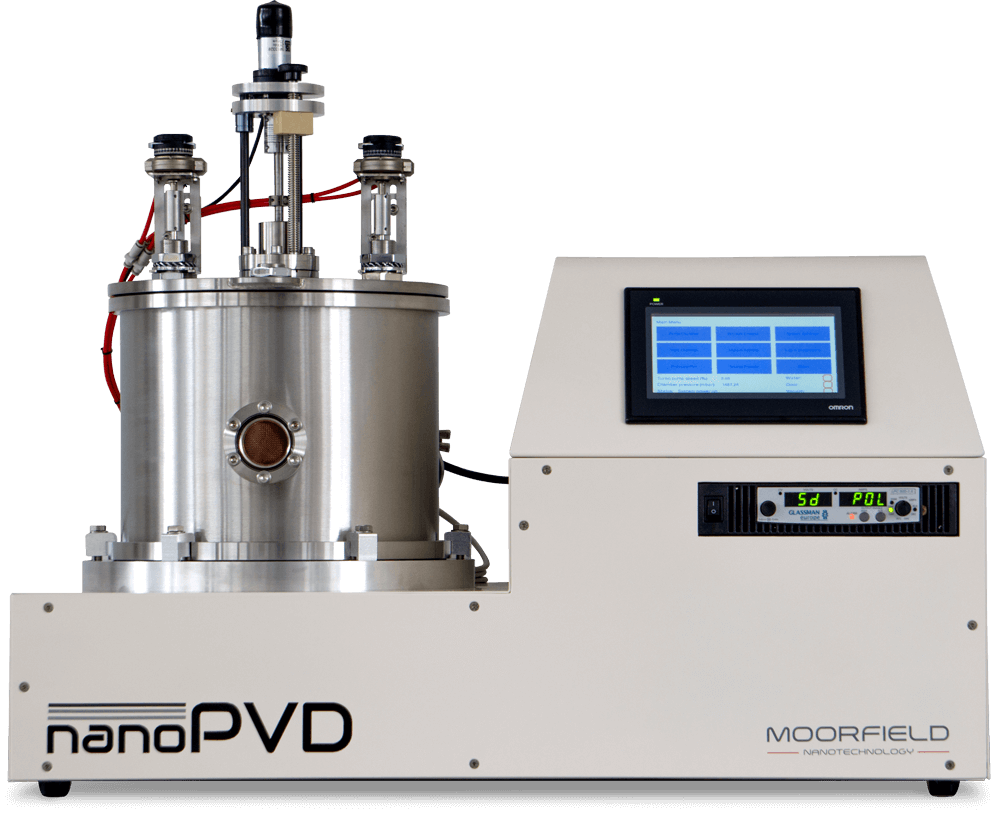
nanoPVD benchtop systems
Compact deposition systems for local sputtering, evaporation and combined thin-film process development.
Explore
Material selector
Look up chart-based deposition guidance by material before starting a configuration discussion.
ExploreContinue learning
Related technique guides
Move between technique pages to compare process families before using the selector or contacting Moorfield.
Next step
Need help choosing a process?
Tell Moorfield about your material set, substrate size, source preference and target film stack. We can help identify a practical platform and configuration.
Nanoparticle vacuum deposition
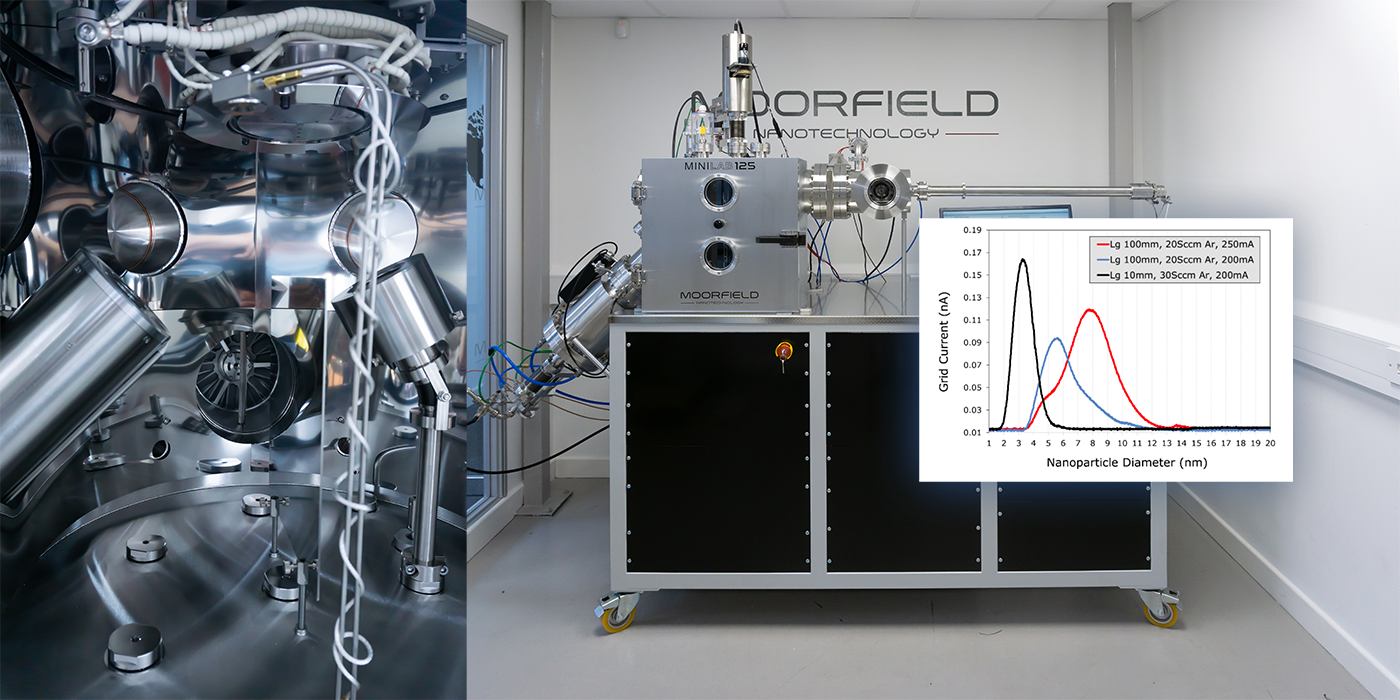
Nanoparticle vacuum deposition sources allow for the deposition, under high-vacuum conditions, of nanoparticles with sizes in the range of 1–20 nm. The sources can be fitted to MiniLab systems with process chambers customised for accepting the necessary hardware.
Nanoparticle vacuum deposition sources use sputtering to eject material from targets (up to 3 can be fitted to each source) positioned at one end of the source. Using a complex differential pumping system, controlled independently from that of the process chamber, the material is guided through the length of the source to emerge from an orifice at the far end as a stream of nanoparticles that are aimed at substrates. Substrates are supported on stages that can be equipped with the wide range of functionalities available as standard with the MiniLab range including heating, cooling, tilt, rotation and bias.
With fine control of process, substrates can be coated with nanoparticles of particular size ranges. Sources can also be equipped with quadrupole mass spectrometry (QMS) modules for characterising the nanoparticle sizes as they are being coated.
The sources can be combined with other techniques such as magnetron sputtering inside the same chamber, allowing for highly versatile vacuum deposition systems.
We have recently designed, built and installed our first MiniLab tool with a nanoparticle vacuum deposition source at the group laboratories of Professor Christian Mitterer at Montanuniversität Leoben in Austria.
