

Home > Technique resource > Chemical vapour deposition
CVD technique
Chemical vapour deposition
Chemical vapour deposition, or CVD, uses gas-phase chemistry at controlled temperature and atmosphere to grow or deposit materials on a substrate. Moorfield currently presents nanoCVD-8G as the relevant compact CVD product on the staging site.

Plain language guide
What this means in practice
Chemical vapour deposition, or CVD, grows or deposits material from reactive gases rather than from a solid target. It is common in semiconductor and carbon-material research, but the correct system depends heavily on gases, temperature and safety requirements.
What happens in the system
- Reactive gases are introduced into a heated process environment.
- Gas-phase chemistry or surface reactions form the target material on the substrate.
- Exhaust handling, temperature profile, substrate material and gas compatibility define the practical system design.
What changes the result
- CVD is chemistry-led, so precursor safety and exhaust handling are part of the equipment decision.
- Growth temperature and substrate compatibility can be limiting factors.
- For simple metal contacts or low-temperature films, PVD may be a more suitable process family.
Questions to answer first
- Are you trying to grow graphene/carbon material or deposit a film by gas chemistry?
- Which gases, temperatures and substrate materials are required?
- Would PVD, plasma etch or anneal be separate steps in the same workflow?
Further reading
Useful external explainers
These neutral references are included to help newer readers understand the underlying process family. Moorfield system suitability still depends on a configuration discussion.
When it helps
Where this technique fits in research workflows
Gas-phase process development for graphene and selected carbon nanomaterial workflows. Moorfield can help connect the process requirement to a practical benchtop or modular configuration without treating the guide as a final specification.
Graphene process development
Consider nanoCVD where the workflow involves CVD growth or processing of graphene and related carbon materials.
Temperature and gas control
Define substrate, gases, temperature profile and exhaust/safety requirements before specifying a CVD system.
Dedicated CVD capability
A compact CVD platform can keep early process work closer to the research team.
Configuration thinking
Map the process need to a platform discussion
The table below is guidance for early selection conversations. It deliberately avoids over-specifying performance before Moorfield has reviewed the material set and lab environment.
| Research need | Relevant process consideration | Potential Moorfield fit |
|---|---|---|
| Graphene or carbon nanomaterial work | CVD gas-phase process development | nanoCVD-8G |
| Need deposition rather than growth chemistry | Consider PVD instead of CVD | nanoPVD or MiniLab discussion |
| Need plasma etch or cleaning | Separate plasma process requirement | nanoETCH discussion |
Relevant platforms
Systems to consider
Start with the process requirement, then compare platform size, source options, atmosphere control, substrate handling and future expansion needs.
nanoCVD-8G
Compact CVD platform for graphene and carbon nanomaterial process development.
Explore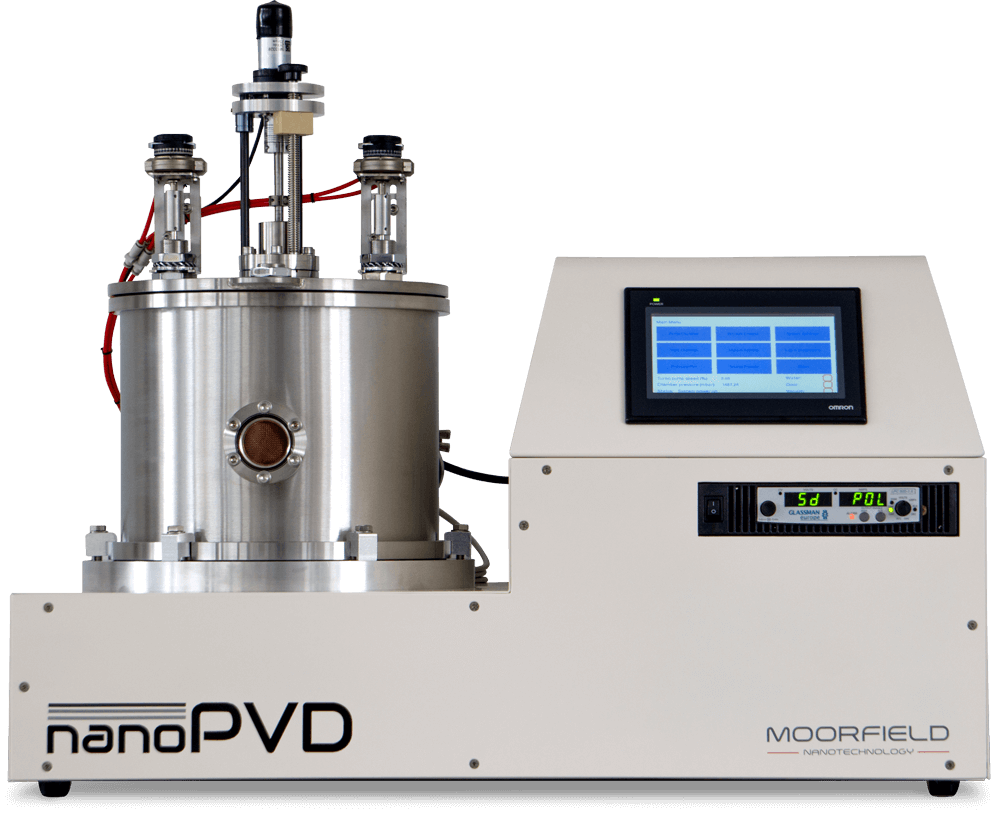
nanoPVD benchtop systems
Compact deposition systems for local sputtering, evaporation and combined thin-film process development.
Explore
nanoETCH
Benchtop plasma etch and surface-preparation capability for research-scale RIE and soft-etch workflows.
ExploreContinue learning
Related technique guides
Move between technique pages to compare process families before using the selector or contacting Moorfield.
Next step
Need help choosing a process?
Tell Moorfield about your material set, substrate size, source preference and target film stack. We can help identify a practical platform and configuration.
Chemical vapour deposition
Moorfield’s nanoCVD range allow for rapid, cost-effective production of graphene using scalable Chemical Vapour Deposition (CVD) methods.
Developed together with academic partners and with proven performance including high-impact publications.
Graphene has been the focus of huge research efforts, given its unique electrical, mechanical and structural properties. Thanks to these properties, Graphene is expected to prove disruptive for a huge range of applications. In addition, exotic characteristics of these materials mean they will enable new types of devices and products.
nanoCVD systems from Moorfield are designed to produce conditions that allow for rapid, cost-effective production of graphene through the implementation of chemical vapour deposition (CVD) schemes. CVD methods are considered most promising for the industrial production of high-quality carbon nanomaterials.
System development has been carried out in collaboration with academic partners and has been awarded financial support for innovation. The tools are compact, easy-to-use and offer proven performance (including peer-reviewed publications in high profile journals).
