

Home > Technique resource > Glovebox integrated systems
Integration guide
Glovebox integrated systems
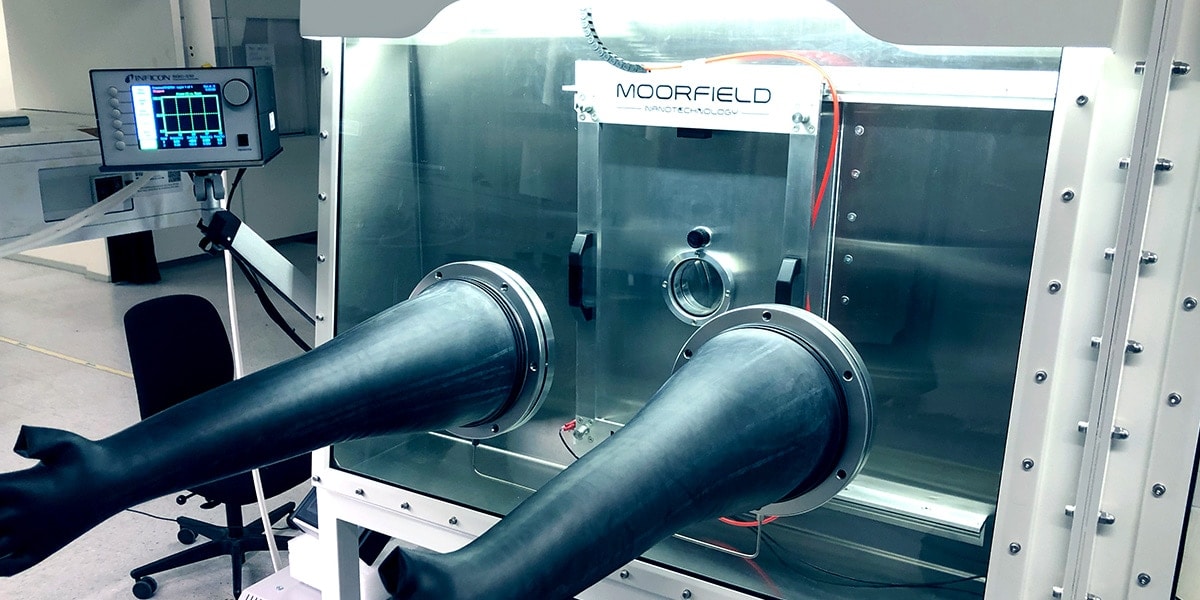
Glovebox-integrated systems are relevant when samples or films are sensitive to oxygen, moisture or handling exposure. Moorfield MiniLab systems can be configured around protected transfer and glovebox-compatible deposition workflows.
Plain language guide
What this means in practice
Glovebox-integrated deposition is used when samples must avoid oxygen or moisture before, during or after processing. The aim is to connect controlled-atmosphere handling with deposition or process hardware so sensitive materials are not exposed between steps.
What happens in the system
- Samples or source materials are handled inside an inert atmosphere, commonly nitrogen or argon.
- Transfer hardware or chamber interfaces are designed so the sample can move into the process tool with reduced exposure.
- The deposition, etch or anneal step is specified around both the process requirement and the protected-handling requirement.
What changes the result
- The glovebox interface, transfer port, chamber pumping and material handling plan all need to be reviewed together.
- A glovebox protects materials from atmosphere but does not remove the need for source compatibility and process control.
- Air-sensitive workflows often require more attention to loading, venting, sample storage and post-process transfer.
Questions to answer first
- Which step is atmosphere-sensitive: source loading, substrate handling, deposition, transfer or storage?
- What oxygen/moisture exposure can the material tolerate?
- Does the process need evaporation, sputtering, plasma treatment, anneal or a combination of these steps?
Further reading
Useful external explainers
These neutral references are included to help newer readers understand the underlying process family. Moorfield system suitability still depends on a configuration discussion.
When it helps
Where this technique fits in research workflows
Protected deposition and process integration for air-sensitive or contamination-sensitive research materials. Moorfield can help connect the process requirement to a practical benchtop or modular configuration without treating the guide as a final specification.
Air-sensitive materials
Consider glovebox integration where exposure between deposition steps would compromise the sample or film.
Hybrid device stacks
Protected workflows can support organic, 2D, molecular and hybrid materials research where appropriate.
Modular configuration
Integration details depend on glovebox type, transfer interface, chamber layout and process hardware.
Configuration thinking
Map the process need to a platform discussion
The table below is guidance for early selection conversations. It deliberately avoids over-specifying performance before Moorfield has reviewed the material set and lab environment.
| Research need | Relevant process consideration | Potential Moorfield fit |
|---|---|---|
| Air-sensitive deposition | Glovebox-compatible PVD by configuration | MiniLab 090 or glovebox PVD discussion |
| Protected evaporation or sputtering | Select process hardware around material sensitivity | MiniLab platform discussion |
| Need plasma or anneal around protected workflow | Review chamber separation and transfer needs | MiniLab/nanoETCH/nanoANNEAL discussion |
Relevant platforms
Systems to consider
Start with the process requirement, then compare platform size, source options, atmosphere control, substrate handling and future expansion needs.

MiniLab modular PVD
Configurable modular platforms for more complex source, chamber, transfer and sample-handling requirements.
Explore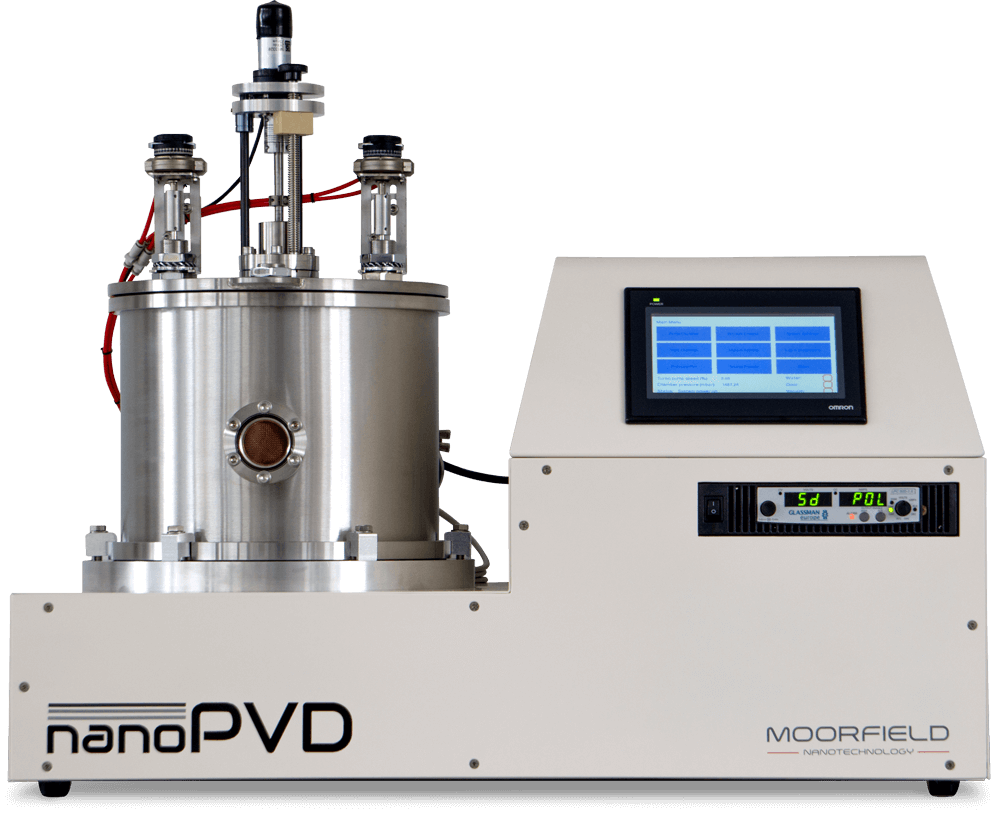
nanoPVD benchtop systems
Compact deposition systems for local sputtering, evaporation and combined thin-film process development.
Explore
nanoETCH
Benchtop plasma etch and surface-preparation capability for research-scale RIE and soft-etch workflows.
ExploreContinue learning
Related technique guides
Move between technique pages to compare process families before using the selector or contacting Moorfield.
Next step
Need help choosing a process?
Tell Moorfield about your material set, substrate size, source preference and target film stack. We can help identify a practical platform and configuration.
Glovebox integrated systems
Glovebox-compatible MiniLab systems for physical vapour deposition (PVD), etching and annealing processes.
For many applications, such as OLED, OPV and OTFT research, and graphene and 2D materials, samples are sensitive to oxygen and moisture and handling within inert environments is a must. In these cases, deposition tools must allow for transfer to and from glovebox enclosures with controlled inert atmospheres.
In addition to vacuum deposition, Moorfield can also equip glovebox-integrated tools with other hardware such as etching (including soft-etching) and annealing components.
Glovebox Setups:
Moorfield is flexible to customer requirements and can provide systems to be integrated with separately-procured gloveboxes or include gloveboxes to form a complete package obtained from one supplier.
Our MiniLab 026/090 tools can be fitted to gloveboxes from most manufacturers including Inert, Vigor and Jacomex. All gloveboxes are available with standard features such as water, oxygen and solvent purification units, oxygen and moisture sensors, transfer antechambers, shelving and lighting.
In all cases, Moorfield is experienced in working with glovebox design teams to provide hassle-free solutions.
Configurations:
Examples of combined MiniLab/glovebox setups include:
- A single glovebox section housing a MiniLab tool.
- A single glovebox section containing a MiniLab tool together with a spin-coater.
- A two-section glovebox system with a MiniLab tool in one section and a spin-coater in the other, allowing for independent solvent and deposition work.
