
Publication Title:

Cadmium and Zinc-Doped p-type Sb2Se3 Single Crystals and Solar Cells
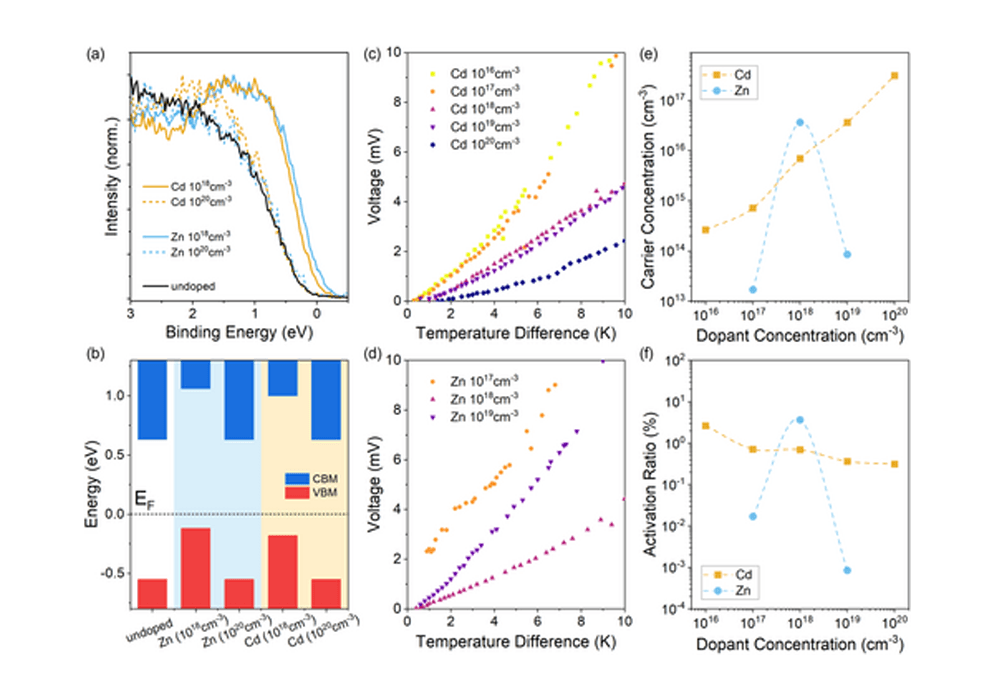
Achieving controlled p-type doping in Sb2Se3 is critical for its development as a photovoltaic absorber. In this work, the incorporation of Cd and Zn as extrinsic dopants in Sb2Se3 single crystals and thin films, with concentrations ranging from 1016 to 1020 , is investigated. Both dopants successfully induce p-type conductivity, but Cd consistently yields lower resistivities and avoids compensation over a wider range of dopant concentrations. Cd-doped Sb2Se3 single crystals exhibit hole densities exceeding 10 , while thin films achieve over 10 , values suitable for efficient solar cell operation. A shallow 22 meV acceptor level appears to be compensated by a deeper lying state around 389 meV, which is intrinsic to Sb2Se3 and limits the achievable free hole concentration. Despite this, solar cells fabricated using Cd-doped Sb2Se3 (at 10 ) show enhancements in open-circuit voltage by ≈60 and ≈20 mV for devices prepared via thermal evaporation and close-spaced sublimation respectively, relative to n-type Cl-doped Sb2Se3. These results establish Cd as a promising dopant for enabling robust p-type conductivity and enhancing the photovoltaic performance of Sb2Se3-based devices.
How Moorfield products helped:
MiniLab080
Thin film deposition
The TE-Sb2Se3 films were evaporated onto CdS coated TEC15 glass substrates in a Moorfield MiniLab 080 thermal evaporator at a rate of 0.2 Å s.
Open Access publication details:
Thomas P. Shalvey, Theodore D. C. Hobson, Frank Herklotz, Reelika Kaupmees, Aeshah A. Almushawwah, Bradley G. Lewis, Christopher H. Don, Sean R. Kavanagh, David O. Scanlon, Vin Dhanak, Maarja Grossberg-Kuusk, Eduard Lavrov, Ken Durose, Jonathan D. Major https://doi.org/10.1002/aesr.202500386
View full Open Access Paper