

Publication Title:
Real-world applications of Moorfield products in science
Insights into the Self-Inhibiting Photoreduction
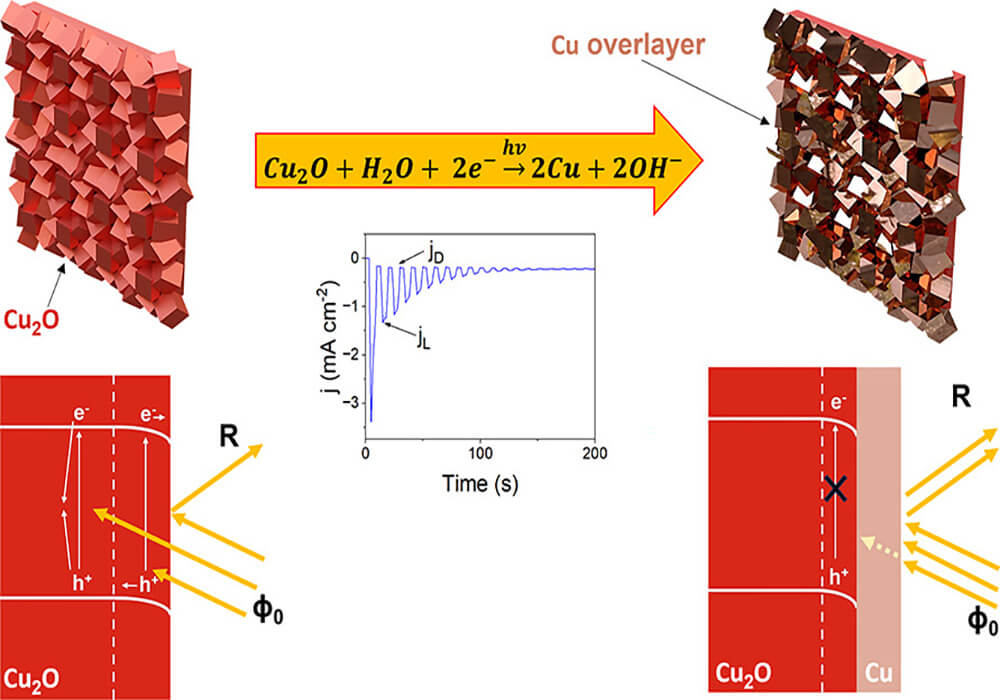
Insights into the Self-Inhibiting Photoreduction of Cu2O in Bicarbonate Electrolytes
Cuprous oxide (Cu2O) has long been regarded as the quintessential photoelectrochemical cathode due to its narrow band gap, native p-type behavior, and low cost. However, it is not stable in aqueous electrolytes upon irradiation, limiting its potential application for producing hydrogen or converting wastewater or CO2 by using direct sunlight. Although Cu2O’s instability is well-documented, the mechanism and factors governing its photocurrent decay over time are not. In this work, electrodeposited Cu2O layers with increasing thickness were synthesized to investigate their transient structure–photocurrent density relationships in bicarbonate electrolytes. The photocurrent decay for all the thicknesses could be modeled by an exponential function with an initial photocurrent jph,0 and a decay rate constant c. It was found that jph,0 follows the Gärtner equation, while the contraction of the space charge layer and the light-dampening effect of the metallic Cu overlayer were evaluated to explain c. Finally, the use of a fast reduction kinetics species (NO3–) and the comparison with another electrolyte provided critical insights into the effect of KHCO3 in the self-reduction of Cu2O.
How Moorfield products helped:
miniLab 125
Experimental Method
Cu thin films for UV–vis analysis were deposited on FTO using a magnetron sputter coater (MiniLab 125, Moorfield Nanotechnology) from a Cu target (99.99%, NanoVision). The deposition was performed in Ar at 6 × 10⁻³ mbar with a growth rate of 5.4 Å s–1. The deposition was stopped after reaching the targeted thickness (adjusted by a previously determined correction factor).
Open Access publication details:
Michele Del Moro, Daniel Choukroun, Tom Breugelmans
https://pubs.acs.org/doi/10.1021/acsomega.5c06018