

Publication Title:
Real-world applications of Moorfield products in science
Transmissive Hybrid Metal–Dielectric
Transmissive Hybrid Metal–Dielectric Metasurface Bandpass Filters for Mid-Infrared Applications
Mid-infrared (MIR) spectroscopy plays a pivotal role in molecular identification and biosensing due to its ability to probe characteristic vibrational fingerprints of biomolecules. Plasmonic nanostructures have been explored for MIR applications but suffer from low efficiencies and broad spectral responses caused by intrinsic ohmic losses. All-dielectric metasurfaces, with low optical losses, offer an attractive alternative; however, their functionality is often restricted to reflection-mode operation. This work introduces a hybrid metal–dielectric metasurface designed to operate in transmission mode, specifically tailored for molecular identification in MIR biosensing applications.
How Moorfield products helped:
miniLab 60
Experimental Section
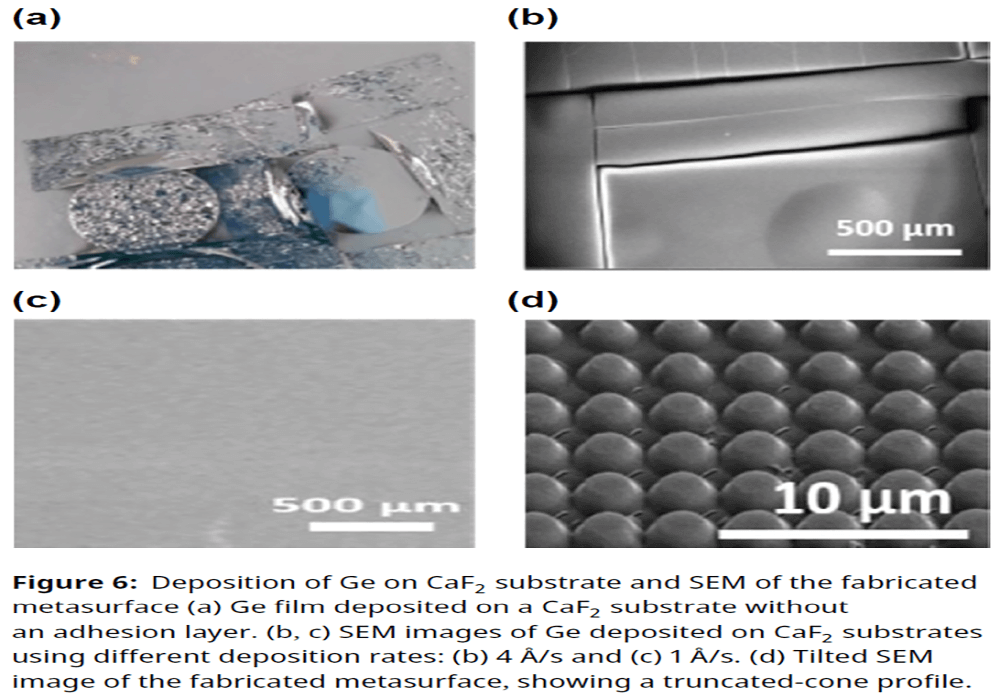
After EBL, Al and Ge were deposited using a thermal evaporator (MiniLab 60, Moorfield Nanotechnology Ltd). Initially, Ge was deposited at a rate of 4 Å/s. SEM image of the films deposited at a rate of 4 Å/s, shown in Figure 6(b) reveals the presence of cracks in the deposited film. High deposition rates have been reported to induce compressive stresses within the deposited film, leading to the formation of cracks [43], [44]. Conversely, lower deposition rates reduce the induced stresses but require extended deposition times, particularly for thicker films. To mitigate the crack formation, the deposition rate was subsequently reduced to 1 Å/s. As depicted in Figure 6(c), the Ge film deposited at 1 Å/s exhibited no cracks, confirming that the lower deposition rate effectively minimized stress and prevented crack formation. Therefore, a deposition rate of 1 Å/s was employed for all subsequent depositions. After the Al and Ge deposition, the substrates were immersed in acetone overnight for the lift-off process.
Open Access publication details:
Amr Soliman, Timothy D. Wilkinson https://doi.org/10.1515/nanoph-2025-0122