

Publication Title:
Real-world applications of Moorfield products in science
One‐Step Construction of Biocompatible Glycine Assemblies
One‐Step Construction of Biocompatible Glycine Assemblies with Exceptional Piezoelectric Performance for Sustainable Electronics
Glycine-based piezoelectric devices hold significant potential in implantable transient bioelectronics due to their biodegradability, easy accessibility, and high predicted piezoelectric responsiveness. However, challenges such as difficulties in large-scale crystal orientation alignment and weak piezoelectricity hinder their practical application. This paper proposes an innovative, simple one-step fabrication method using mussel-inspired dopamine (DA) molecules to synergistically prepare glycine-based devices with exceptional piezoelectric performance. It is found that DA can induce the formation of piezoelectric β-glycine crystals on various substrates via supramolecular interactions, achieving a maximum piezoelectric coefficient of 5.9 pC N−1 and piezoelectric voltage coefficient of 153 × 10−3 V m N−1 in DA/glycine/polydimethylsiloxane films, with significantly enhanced thermal stability (≈120 °C). Furthermore, dopamine molecules can regulate the preferential crystal plane alignment of γ-glycine in polyvinyl alcohol (PVA)/glycine films, increasing their piezoelectric coefficient and voltage coefficient to 10.8 pC N−1 and 369 × 10−3 V m N−1, respectively. Using flexible glycine-based films, piezoelectric force biosensors are fabricated that demonstrate exceptional sensing capabilities for joint flexibility and oral occlusion contact patterns. Additionally, DA/glycine crystals and DA/PVA/glycine films exhibit excellent biocompatibility and biodegradability. This work offers a simple, efficient, and energy-saving approach for fabricating sensitive glycine-based piezoelectric devices, enhancing the application potential of high-performance piezoelectric biomaterials in sustainable bioelectronics.
How Moorfield products helped:
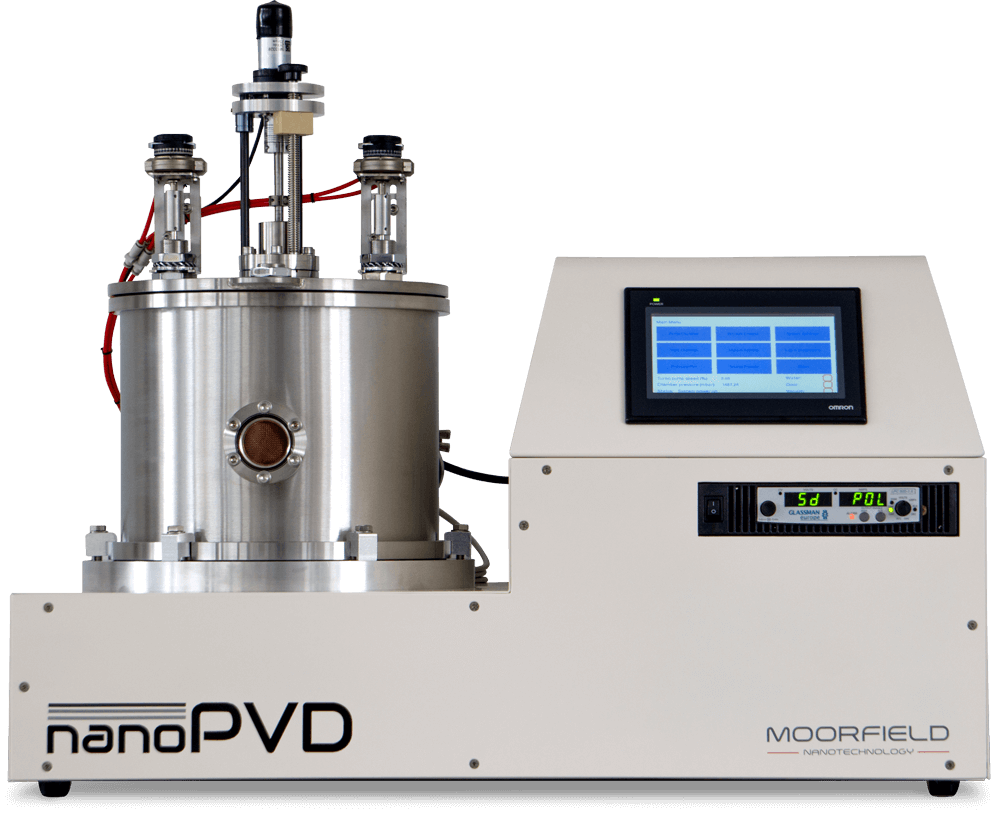
nanoPVD
Experimental Section
nanoPVD was employed to deposit biocompatible Mo electrodes on PDMS, which was essential for creating the DA/glycine and DA/PVA/glycine-based mechanical sensors. This deposition process ensured the sensors were both effective and safe for potential biomedical applications, contributing significantly to the study’s objectives of developing sustainable and biocompatible piezoelectric devices.”
Open Access publication details:
Xin Tan, He Wang, Kai Wang, Xiaoke Zhang, Huifen Ding, Shuhong Li, Jie Li, Jinlin Song https://doi.org/10.1002/adfm.202506107