
Publication Title:

Influence of Sputtering DC Sputtering Power on the Surface Evolution of Ti Thin Films: A Fractal Description
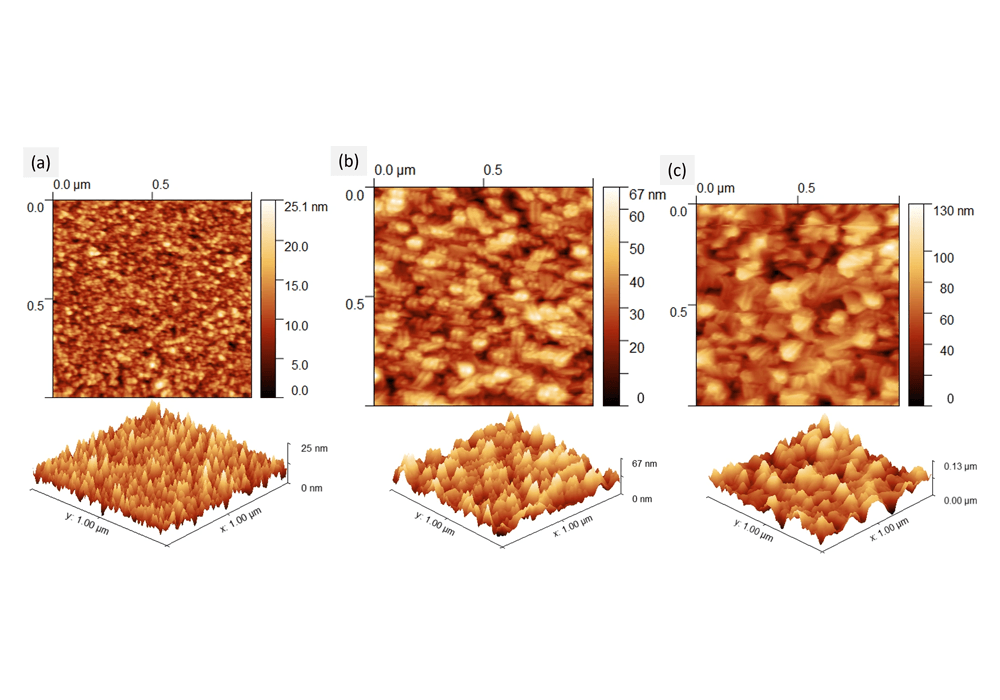
The power applied during magnetron sputtering plays an important role in determining thin-film growth, morphology, and surface evolution. This paper studies how sputtering power influences titanium (Ti) thin films deposited on glass substrates, with a focus on topography, crystallinity, and fractal growth behaviour.
Ti thin films were deposited using direct current magnetron sputtering from a pure Ti target at 15% (54.12 W), 30% (109.70 W), and 50% (188.17 W) of the system’s maximum capacity. The films were characterised using atomic force microscopy (AFM), field emission scanning electron microscopy (FESEM), and x-ray diffraction (XRD). The study reports that film thickness, grain size, and roughness increased with deposition power. The samples were mostly amorphous, although a weak Ti (002) peak was observed at 30% and 50% power. Fractal analysis further indicated that the fractal dimension decreased with increasing power, while multifractality strength increased.
How Moorfield products helped:
nanoPVD
Ti thin film deposition
Ti thin films were deposited on soda lime glass substrates (dimensions 75 mm 9 25 mm 9 1 mm) using a benchtop nanoPVD-S10A DC magnetron sputtering system.
Open Access publication details:
F. M. Mwema, J. M. Wambua, Tien Chien Jen, E. T. Akinlabi https://doi.org/10.1007/s11837-024-07012-4
View full Open Access Paper