

Publication Title:
Real-world applications of Moorfield products in science
Free-Standing Boron Doped Diamond Slot Electrodes
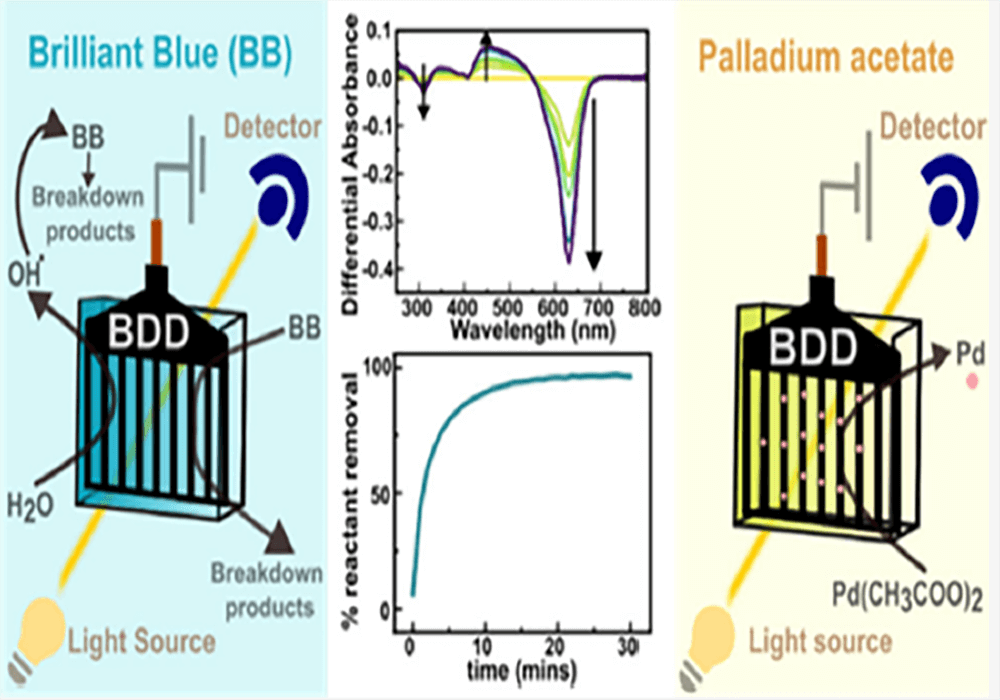
Free-Standing Boron Doped Diamond Slot Electrodes for UV−Visible Spectroelectrochemistry: Electrochemical Advanced Oxidation and Metal Ion Reduction
Boron doped diamond (BDD) has numerous advantages as an electrode material such as having a wide aqueous solvent window, water oxidation, which is thought to produce weakly adsorbed hydroxyl radicals, low background currents, and high electrochemical stability. While BDD has received interest as an optically transparent electrode for combined UV-Vis electrochemical measurements, there are no studies which use it in applications which capitalize significantly on the properties of BDD. In this paper, we describe the use of a BDD spectroelectrochemical (SEC) electrode, BDDSEC, fabricated from free-standing BDD (400 μm thickness) and containing laser-micromachined slot-shaped holes (360 μm wide). The electrode shows an optical transmittance of 63% within the wavelength range of 200 to 800 nm, which is the highest reported transmittance for a BDD SEC. UV-Vis electrochemical characterization measurements are made using the redox couple Ru(bipy)3 2+/3+ over a wavelength range that indium tin oxide electrodes struggle to access due to high background absorption in the UV region. Time scales for Ru(bipy)3 2+ conversion to Ru(bipy)3 3+ in this setup are ascertained. We demonstrate the first operando measurements for removal of a UV-Vis active molecule (brilliant blue) using BDDSEC electrodes under advanced oxidation conditions. From the change in the UV-Vis absorption signal with time, comparative measurements of the removal rate as a function of applied potential can be obtained; specifically rate constants of 0.10 min−1 (1.04 V), 0.24 min−1 (at 1.39 V), and 0.68 min−1 (at 2.22 V) vs Ag|AgCl (3 M Cl- ) are determined for this experimental arrangement. At the highest potential, we propose both direct and indirect oxidation (via production of hydroxyl radicals from water) are possible. As a second application, we demonstrate the viability of the BDDSEC electrode for quantifying metal ion removal rates (via electroreduction) from different solvent systems. Specifically, we consider electrochemical removal of Pd from Pd−acetate in aqueous acid and in a mixed water:acetonitrile solution.
How Moorfield products helped:
nanoPVD
Experimental Method
The contact pad area of the electrode (Figure S1, Supporting Information, SI 1.1) was laser-roughened (fluence = 20 J cm−2) to improve the adhesion of the electrical contact, formed by deposition of a trimetal stack of Ti (50 nm)|Pt (50 nm)|Au (200 nm), using a NanoPVD deposition system (Moorfield, UK).
Open Access publication details:
Anjali John, Anna Dettlaff, Joshua J. Tully, and Julie V. Macpherson.
https://doi.org/10.1021/acselectrochem.5c00085