

Publication Title:
Real-world applications of Moorfield products in science
Concurrent Biocompatibility and Antimicrobial Functionality
Concurrent Biocompatibility and Antimicrobial Functionality of Soft Diamond-Like Carbon Coating for Healthcare Applications
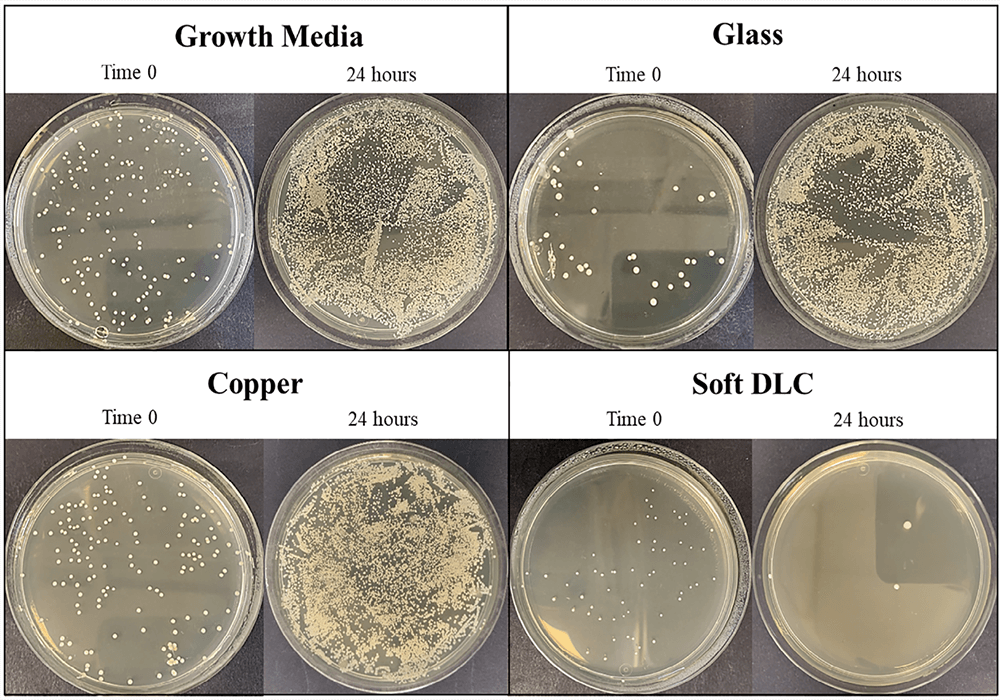
This unprecedented study reveals the excellent antimicrobial performance of soft, hydrogen-free, pristine diamond-like carbon (DLC) coatings against life-threatening methicillin-resistant Staphylococcus aureus (MRSA). In addition, most previous studies have separately reported the biocompatibility and antimicrobial performance of DLC coatings, perhaps due to a nuance between antimicrobial performance and cytotoxicity. However, this work concurrently reports the biocompatibility of soft DLC with mouse fibroblast L929 cells and its antimicrobial performance against MRSA, where concurrent reporting is desirous for holistic material assessment, regulatory consideration, and enhanced safety and efficiency for biomedical applications. The soft DLC coatings are prepared with direct-current, open-field, magnetron sputtering, and characterized for structural, physical, mechanical, and electrical properties. The soft DLC coatings show excellent biocompatibility with 168 h leached extracts and antimicrobial performance after 24 h superior to copper, an established antimicrobial agent. This work proposes soft DLC as a safe material for concurrent biocompatibility and antimicrobial actions, as desired in most healthcare applications.
How Moorfield products helped:
nanoPVD
Specimens Preparation
Soft DLC coatings were deposited on Fisher-brand glass substrates (76 × 26 × 1 mm) for structural, physical, electrical, mechanical, biocompatibility, and antimicrobial studies. A silicon wafers(20 × 20 × 1 mm) were used for Raman spectroscopy, while bulk specimens of Ti alloy (Ti6Al4V/Grade 5/AMS4911/Brindley Metal, Powys, UK),Cu 101 (99.99% pure, Metal Supermarket, Gateshead, UK), and glass (all26 × 19 × 1 mm, Fisherbrand UK) were used as controls for biocompatibility and antimicrobial studies. The hydrogen-free soft DLC coatings were deposited using a Moorefield NanoPVD direct-current, open-field, magnetron sputtering system.
nanoPVD was instrumental in the deposition of hydrogen free soft DLC coatings, which were then evaluated for their biocompatibility and antimicrobial properties. The precision and control offered by the nanoPVD system ensured the coatings met the necessary specifications for the study. These coatings demonstrated excellent biocompatibility and superior antimicrobial performance against MRSA, making them a promising material for healthcare applications.
Open Access publication details:
Abdul Wasy Zia, Alberto Tuñón-Molina, Ioannis Anestopoulos, Miguel Martí, Iraklis-Stavros Panagiotidis, Anam Ijaz, Ángel Serrano-Aroca, Mihalis I Panayiotidis, Martin Birkett. https://doi.org/10.1002/adhm.202501224