
Publication Title:

Quantum Sensing of Copper-Phthalocyanine Electron Spins via NV Relaxometry
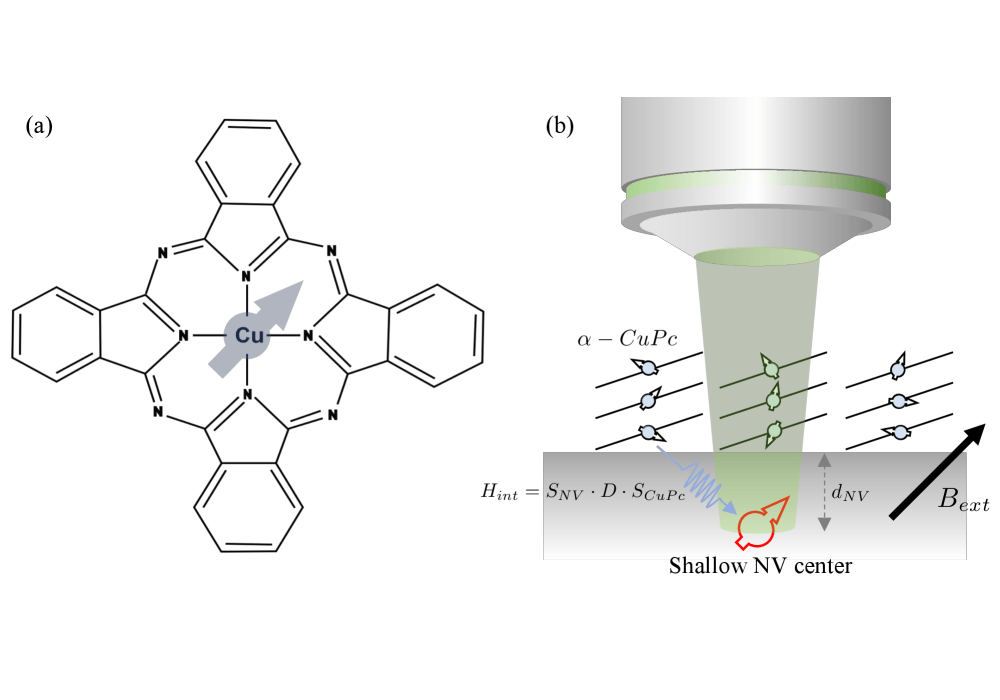
Organic molecular spin systems are of interest for quantum sensing and spin-based information technologies, but characterising their spin dynamics can be challenging due to fast decoherence and weak signals. This work demonstrates the use of nitrogen-vacancy (NV) centres in diamond as nanoscale quantum sensors to probe the electron spin ensemble of copper-phthalocyanine (CuPc) thin films.
The researchers used NV-centre T1 relaxometry to detect magnetic noise generated by CuPc electron spins at room temperature. By analysing the relaxation spectra of shallow NV centres located near the film surface, the study identified the hyperfine signature of CuPc spins and extracted key parameters describing the spin ensemble behaviour.
The analysis allowed the correlation time of the CuPc spin ensemble and the orientation of the local lattice environment to be determined. The work also demonstrates that NV relaxometry can be used to estimate the depth of individual NV centres with approximately 1 nm precision. These results show how quantum sensing techniques can provide nanoscale insight into molecular spin systems.
 Figure 3 from the publication: NV relaxation spectra used to extract CuPc spin dynamics.
How Moorfield products helped:
nanoPVD
Thin-film deposition for molecular spin studies
The deposition was conducted by thermal evaporation of CuPc powder (Millipore Sigma, > 99%) in a physical vapor deposition system (nanoPVD-T15A, Moorfield Nanotechnology) under a vacuum of ∼ 1 × 10⁻⁶Torr.
Open Access publication details:
Boning Li, Xufan Li, Yifan Quan, Avetik R. Harutyunyan, Paola Cappellaro. Quantum Sensing of Copper-Phthalocyanine Electron Spins via NV Relaxometry. arXiv (2025). https://doi.org/10.48550/arXiv.2511.03200
View full Open Access Paper