
Publication Title:

High-sensitivity ethanol vapor detection using In2O3@ZnO core-shell nanomeshes fabricated via block copolymer templating
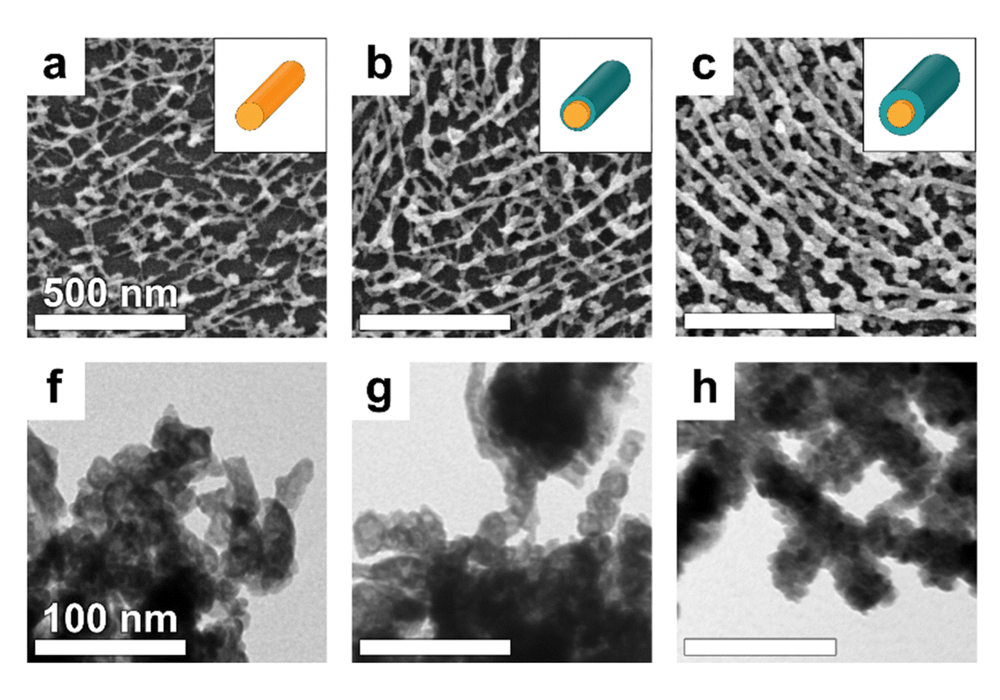
Detection of low concentrations of volatile organic compounds requires sensing materials with high surface area, stable electrical behaviour, and reproducible fabrication methods. In this paper, the researchers used a block copolymer templating approach to fabricate porous indium oxide (In2O3) nanowire meshes, followed by zinc oxide (ZnO) shell deposition to form core-shell heterostructures for ethanol sensing.
The sensing structures were prepared from PS-b-P2VP block copolymer films infiltrated with an indium precursor and converted to In2O3 nanowire replicas by oxygen plasma treatment. ZnO shells of different thicknesses were then deposited by atomic layer deposition, and the resulting structures were annealed to improve crystallinity. The optimized In2O3@ZnO nanomeshes with a 10 nm ZnO shell, annealed at 400 °C, showed a response of approximately 245 at 100 ppm ethanol and a sensitivity of approximately 2.28 ppm−1 over the 10–100 ppm range. The paper also reports stable performance in both dry air and ambient humidity conditions.


How Moorfield products helped:
nanoPVD-T15A
Electrode fabrication
Interdigitated electrodes were patterned by photolithography, followed by thermal evaporation of 4 nm Cr as an interface layer and 75 nm Au as the electrode material using a Moorfield nanoPVD-T15A system.
Open Access publication details:
Przemyslaw Pula, Zofia Z. Zawistowska, Julia Krol, Magdalena M. Majewska, Maciej Krajewski, Paulina Chyzy, Mariya V. Dobrotvorska, Maria Kaminska, Mikołaj Lewandowski and Pawel W. Majewski, RSC Advances, 2026, 16, 4694–4707. https://doi.org/10.1039/D5RA07053H
View full Open Access Paper